QuantWealth Advisors

Categories
QuantWealth

The Active Decision Inside Every Passive International Portfolio

International index investing works differently from domestic index investing. Before anyone can build an index for “the international market,” someone has to decide which countries count as developed, which count as emerging, which qualify as investable at all, and how much weight each one gets in the final portfolio. None of those questions has an objectively right answer. The three major index providers — FTSE Russell, MSCI, and S&P Dow Jones Indices — have answered them differently for a quarter century, and their disagreements quietly reshape the portfolios of every investor who buys their funds.

The largest single disagreement is South Korea. Korea now has the world’s eighth-largest equity market by capitalization, having recently surpassed the United Kingdom on the back of a semiconductor-led rally. The country is home to Samsung Electronics and SK Hynix, two of the most important companies in the global semiconductor supply chain. FTSE classifies it as developed. MSCI classifies it as emerging. S&P sides with FTSE. Where Korea sits in your portfolio — and how much of your portfolio it represents — depends entirely on which index family is behind your ETFs. Most international investors have never thought about this decision.


The three index families

Almost every international ETF available to U.S. investors is built on top of one of three index families:

FTSE Russell is the index arm of the London Stock Exchange Group. FTSE classifies South Korea as a developed market and has done so since 2009. Vanguard’s international ETFs follow FTSE methodology. Schwab’s flagship international fund does as well.

MSCI is the largest of the three by institutional assets and is the standard benchmark most pension funds and endowments measure against. MSCI classifies South Korea as an emerging market and has held that view since 1992. iShares uses MSCI methodology for its core international lineup. Avantis and Dimensional do too.

S&P Dow Jones Indices runs the S&P 500 and is the third major provider. S&P has classified South Korea as a developed market since 2001. State Street’s SPDR portfolio international funds follow S&P methodology.

Two of the three providers say developed but one says emerging.


Four emerging-markets ETFs, four very different Korea exposures

Look at the four most widely used emerging-markets ETFs in the U.S. market and the consequences of these classification choices become clear.

ETFIssuerIndexKorea Weight
IEMGiShares (BlackRock)MSCI EM IMI15.4%
VWOVanguardFTSE Emerging0%
SPEMState Street SPDRS&P Emerging BMI0%
AVEMAvantisMSCI EM IMI (active)15.6%

Korea weights as of recent fund disclosures. AVEM weight as of 3/31/2026 per issuer fact sheet.

Two of the four major emerging-markets ETFs hold zero Korea. SPEM and VWO both follow indexes that classify Korea as developed, so neither owns Samsung Electronics, SK Hynix, or any other Korean stock. An investor who bought either fund expecting “broad emerging markets exposure” was structurally absent from the entire AI memory cycle.

IEMG sits in the middle. The MSCI EM IMI index that BlackRock tracks places Korea at roughly 13% of the fund. That weight has powered IEMG’s recent performance, since Samsung and SK Hynix have been among the largest contributors to MSCI emerging-markets returns since 2024.

AVEM is the highest-Korea fund of the four despite being the only one that’s actively managed. Avantis benchmarks against MSCI EM IMI but tilts the portfolio toward smaller-cap, value, and high-profitability stocks. Korean memory names, which trade at low book multiples and generate strong returns on capital, get systematically overweighted by the model. 

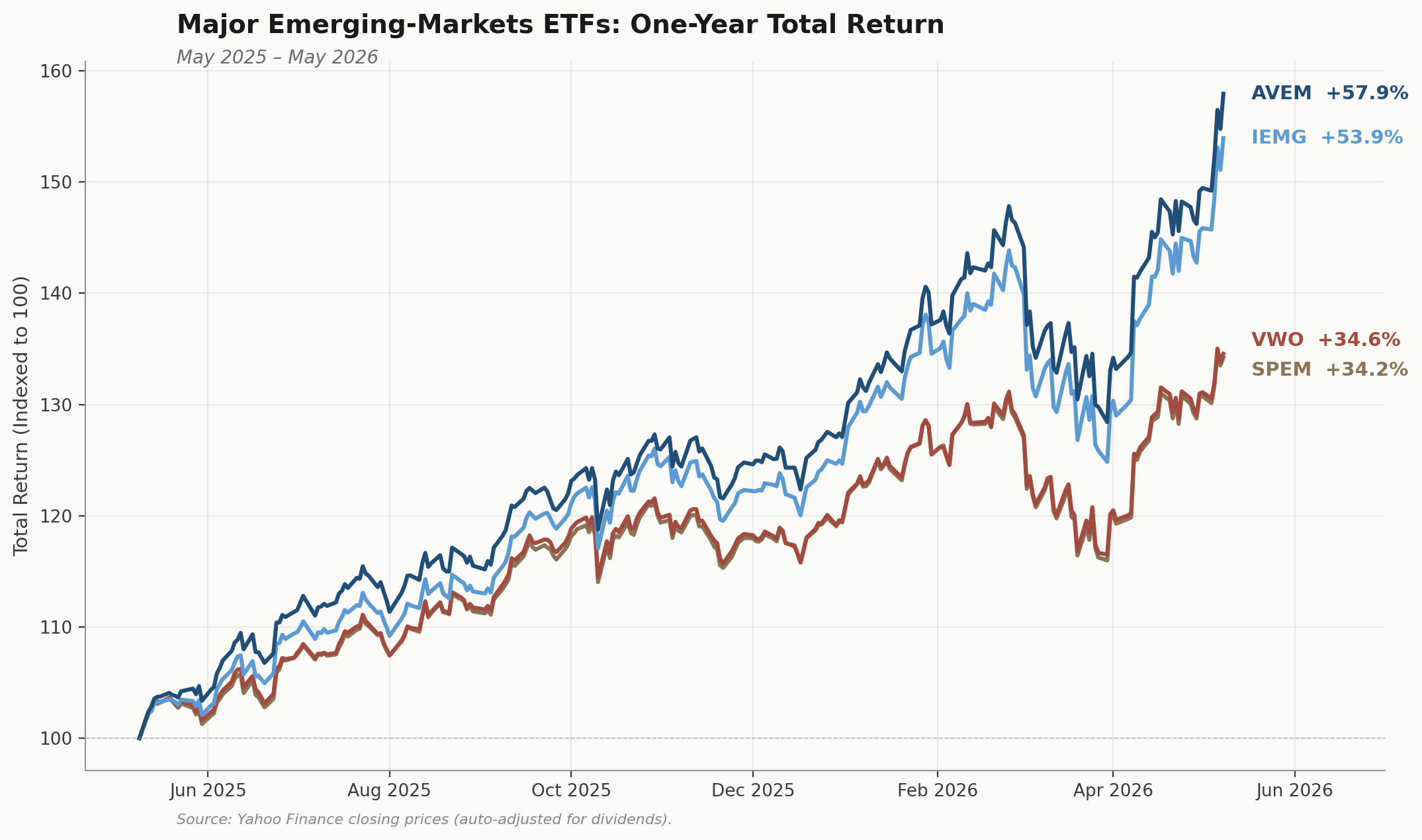
The performance gap over the trailing twelve months ending May 2026 made the math visible:

AVEM (Korea 15.6%) returned +57.9%. IEMG (Korea 13.3%) returned +53.9%. VWO and SPEM, both with zero Korea exposure, returned +34.6% and +34.2% respectively. The gap between the highest-performing fund (AVEM) and the lowest (SPEM) was 23.7 percentage points. All four are marketed as broad emerging-markets ETFs.


Conclusion

Passive portfolios are full of active decisions. Those choices are made by the index provider before the ETF is built, and the investor inherits them whole.

Passive investing is one of the most powerful tools available to long-term investors. It just isn’t as automatic as it looks the moment you cross the U.S. border.


This commentary is provided for informational purposes only and does not constitute investment advice or a recommendation to buy or sell any security. ETF holdings, index weights, and performance figures cited are as of dates referenced and change over time. QuantWealth Advisors LLC is a fee-only registered investment adviser.

Categories
QuantWealth

International Funds: Rethinking Asset Location for Tax Efficiency

 Diversification across global markets has long been a cornerstone of modern portfolio theory. Many investors naturally allocate to international developed and emerging-market funds to broaden exposure beyond U.S. borders.
Most asset-allocation models include at least 20% international equity, and virtually all target-date funds maintain a meaningful global component.

However, few investors consider where those holdings should reside — in taxable or retirement accounts — even though this decision can  impact long-term after-tax returns.


Why International Funds Can Be Tax-Inefficient

Unlike U.S. equities, foreign stocks are subject to dividend withholding taxes imposed by their home countries. These taxes typically range from 0% to 30% of the dividend amount and are non-recoverable inside tax-deferred accounts such as IRAs, 401(k)s, and Roth IRAs.

To make matters worse, international markets tend to have higher dividend yields than U.S. markets.
This occurs because:

  • International companies often have lower valuations/growth profiles and higher payout ratios.
  • Many use dividends instead of stock buybacks to return capital to shareholders.

For example in the most popular ETF which are also available as funds inside 401(k)s:

  • Vanguard S&P 500 ETF (VOO): ~1.15% dividend yield
  • Vanguard Total International Stock ETF (VXUS): ~2.75% dividend yield

 How Inefficient Is It?

Roughly 10% of VXUS’s dividends are withheld by foreign countries each year.
For large-cap, broadly diversified international funds, 10% is a reasonable rule of thumb for “foreign taxes paid.”

That means:

On a 2.75% yield, an investor forfeits roughly 0.3% annually in foreign withholding taxes when holding VXUS in a retirement account.

For context, VXUS’s expense ratio is only 0.05% — meaning this tax drag is six times larger than the fund’s stated expense.

In taxable accounts, investors can typically claim a foreign tax credit on their U.S. return to offset this cost.
But in retirement accounts, there is no credit available — the withholding is a permanent loss.


Dividends in Taxable Accounts: Qualified vs. Non-Qualified

If you hold international funds in a taxable account, you’ll owe tax on their dividends each year.
Here’s the catch: not all dividends are taxed equally.

  • Qualified dividends are taxed at lower long-term capital gains rates (0%, 15%, or 20%).
  • Non-qualified dividends are taxed at ordinary income rates, which can be as high as 37%.

U.S. equity ETFs like VOO typically have 99–100% qualified dividends, meaning almost all their income receives the lower rate.
International ETFs are different is that a lower amount of the dividends are qualified. For VXUS, only ~60% of the dividends are qualified.


Why Only ~60% of VXUS Dividends Are Qualified

VXUS, which tracks the total international market, typically reports only ~60% of its dividends as qualified.
The remaining 40% are taxed at higher ordinary income rates.

There are several reasons:

  1. IRS Treaty Test
    Only dividends from countries with a U.S. tax treaty and proper documentation qualify.
    VXUS holds many non-treaty markets — such as Brazil, Singapore, and Taiwan — disqualifying a large portion of its income.
  2. Corporate Structure
    Some foreign firms operate as holding companies, state-owned entities, or REIT-like structures, whose distributions fail to meet the IRS definition of “qualified dividend income.”
  3. Documentation Gaps
    For a dividend to be reported as qualified, the ETF provider must document eligibility.
    If not verifiable, the IRS requires it be classified as ordinary.

Bottom Line

In spite of the qualified funds, for broad large cap international funds, it still makes sense to put them in taxable accounts instead of tax deferred account since the foreign tax credit can be claimed.

Most investors recognize that bond and fixed-income funds belong in retirement accounts for tax efficiency, whereas international funds typically work better in taxable accounts.

Strategic asset location — not just allocation — can meaningfully improve long-term after-tax outcomes.

Emerging market funds, small cap international funds and global real estate funds have different tax withholding rates and lower qualified dividends. We will explore later whether it makes sense to put them in taxable accounts too


Disclosure

This material is provided for informational and educational purposes only and should not be construed as individualized tax or investment advice.
Investors should consult with a qualified financial advisor or tax professional before making investment or asset-location decisions.
All data sourced from Vanguard fund reports (2022–2024) and public tax documentation as of October 2025.

Categories
QuantWealth

Buy the individual stock or the sector ETF?

Buffett’s Apple (AAPL) purchase is often called one of his greatest bets ever. It checked every box of his investing philosophy while delivering extraordinary absolute returns. Berkshire started buying in Q1 2016 when Apple traded at around $25 (split adjusted). The investment alone accounts for over 40% of Berkshire’s entire stock portfolio at times.

But even Buffett isn’t immune to portfolio management realities. Beginning in late 2023, Berkshire started trimming its Apple stake for tax and concentration reasons, though Apple remains its largest single holding.


Return Comparison

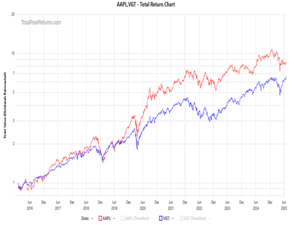
If you had bought Apple stock on 12/31/2015 and liquidated on 6/30/2025:

  • Annualized return: 25.47%
  • Total return: 762.68%

If instead you had bought the Vanguard Information Technology ETF (VGT):

  • Annualized return: 22.20%
  • Total return: 571.38%

On paper, Apple crushed the ETF. But investing is not just about gross returns—it’s about after-tax returns.


Diversification offered by sector ETF’s

Holding a diversified sector ETF also means you don’t have to worry about company-specific risks:

  • Will Apple keep pace in AI?
  • Will Siri ever catch up to competitors?
  • Will regulation hit margins?

Those risks get smoothed out across the broader technology sector. Even Buffett himself—arguably Apple’s biggest champion—has been forced to trim for diversification reasons.


The Tax Drag on Individual Stocks

The challenge with owning a single stock is that you often need to sell at some point—for rebalancing and risk management. Every sale in a taxable account creates a capital gains tax event.

Looking at returns from an after tax perspective for AAPL compared to the before tax returns of VGT, (not an apples to apples comparison), which returns are superior?

  • At a 23.8% rate (20% long-term cap gains + 3.8% NIIT), Apple’s after-tax annualized return falls from 25.47% to 19.41%.
  • At a 33.8% rate (adding high state income taxes), the after-tax return falls further to 16.86%.

The Takeaway

Apple was a once-in-a-generation investment, and Buffett’s timing was exceptional. But for most investors, even a brilliantly placed single-stock bet can lose its edge once taxes and rebalancing needs enter the picture.

Sector ETFs like VGT may not always deliver the highest headline return, but they can deliver a better after-tax experience—and that’s the return that ultimately compounds into wealth.

Categories
QuantWealth

A Good Index, But Not a Good Fund

The Vanguard Extended Market Index Fund (VEXAX) and its ETF counterpart VXF are widely used products with nearly $100 billion in combined assets. Both are market cap–weighted and track the S&P Completion Index.

At first glance, the S&P Completion Index looks appealing: it represents every U.S. stock in the S&P Total Market Index (TMI) except those in the S&P 500. In theory, this gives investors exposure to mid-cap, small-cap, and micro-cap companies across all sectors.

But just as the Russell 2000 was created as a benchmark and later became a investable fund with structural flaws, the S&P Completion Index suffers from design issues that limits it usefulness as an investable fund.


Issues With the S&P Completion Index
  • No Profitability Screen

    Unlike the S&P 500, which only includes companies that have been profitable for at least a year, the Completion Index has no profitability requirement. That leaves it populated with lower-quality firms, distressed businesses, and speculative names.

    The most striking example today: the largest holding in the index currently is Strategy (formerly MicroStrategy, ticker MSTR), essentially a leveraged Bitcoin holding company. Because it can never show consistent profitability under GAAP accounting, it will never qualify for the S&P 500—yet it is the first name on the Completion Index.
  • Large-Cap Creep

    Although designed to track small- and mid-sized companies, the index is built simply by excluding the S&P 500. The result: a surprising amount of large-cap exposure sneaks in. According to VettaFi, nearly 35% of the Completion Index is actually large caps, diluting the intended exposure.

  • Easy Entry for IPOs and SPACs

    To join the S&P 500, companies must meet stricter criteria, including that a significant portion of shares be publicly held. No such guardrail exists for the Completion Index. This means recent IPOs and de-SPACs can enter quickly, often at inflated valuations and without profitability. During speculative surges like 2021, this leads to a flood of overpriced, low-float companies being added—an outcome that harms long-term returns.

  • A Dumping Ground for S&P 500 Discards

    When companies are removed from the S&P 500—often due to shrinking market caps, obsolete business models, or poor management—they don’t disappear. Instead, they slide into the Completion Index. Many of these “fallen angels” languish for years, dragging down performance.


The Few Advantages

The Completion Index does have some benefits:

  • Pipeline to the S&P 500: Companies promoted into the S&P 500 start out in the Completion Index, so investors can benefit from the “index pop” when those stocks are included in the S&P 500.
  • Low Cost and Tax Efficient: Like most Vanguard index products, VEXAX and VXF are inexpensive and tax-friendly, avoiding the inefficiencies of active management.

Key Takeaways

The S&P Completion Index is a good benchmark but a flawed fund. Its lack of profitability screens, large-cap creep, easy inclusion rules for speculative IPOs/SPACs, and role as a dumping ground for fallen S&P 500 companies make it less attractive as a core holding.

With so many alternatives for small- and mid-cap exposure, this is not a fund I’d put at the top of the list.

Categories
QuantWealth

Is Berkshire Hathaway a Predictor of the S&P 500?

Berkshire Hathaway’s stock often plays a unique role in markets. Like gold, it can act as a safe haven: when investors get nervous, they shift into Berkshire, trusting Warren Buffett’s ability to seize opportunities in downturns — just as he did in 2008 by buying distressed assets during the financial crisis.

But beyond being a “safety trade,” could Berkshire Hathaway stock also serve as a predictive signal for the S&P 500?


Berkshire vs. the S&P 500: Correlation Patterns

The chart below shows the 3 month rolling correlation between Berkshire Hathaway (BRK.A) and the S&P 500, plotted alongside the index itself:

An interesting pattern emerges. Each time the correlation dips below 0.4, a notable market drawdown has followed:

  • Early 2022 – Correlation fell below 0.4, followed by the S&P 500’s sharp decline as inflation surged and the Fed launched aggressive tightening.

  • August 2023 – Another dip below 0.4 preceded a 10.3% correction, triggered by “higher for longer” rate expectations.

  • March 2024 – The breakdown came ahead of a 5.4% drawdown.

  • June 2024 – A sustained drop below 0.4 preceded an 8.5% selloff, driven by the yen carry trade unwind.

  • Post-Election 2024 – Correlation again slipped under 0.4, foreshadowing the nearly 20% drawdown sparked by tariff fears.


Where We Stand Now

As of today, the Berkshire–S&P 500 correlation has once again fallen below 0.4.

History suggests this may be a warning sign of turbulence ahead. Of course, correlations don’t predict markets with certainty — but when a signal repeats across multiple cycles, it deserves investor attention.


Why It Matters
  1. Global sentiment proxy. Berkshire stock often reflects investor caution, as capital flows to Buffett’s fortress balance sheet during uncertain times.

  2. A potential early warning system. While not foolproof, the repeated pattern of low correlation preceding drawdowns suggests Berkshire may act as a leading indicator of stress.

  3. Risk management reminder. Whether or not history repeats this time, investors should use these signals to revisit allocations, diversification, and risk exposure.


Key Takeaway

Berkshire Hathaway isn’t just a conglomerate — it may also serve as a barometer of market sentiment. Each time its correlation with the S&P 500 has slipped below 0.4, the broader market soon experienced meaningful downside.

We’re seeing that signal again today. Whether it proves to be another warning shot or simply a statistical coincidence remains to be seen — but for investors, it’s a reminder to stay vigilant.